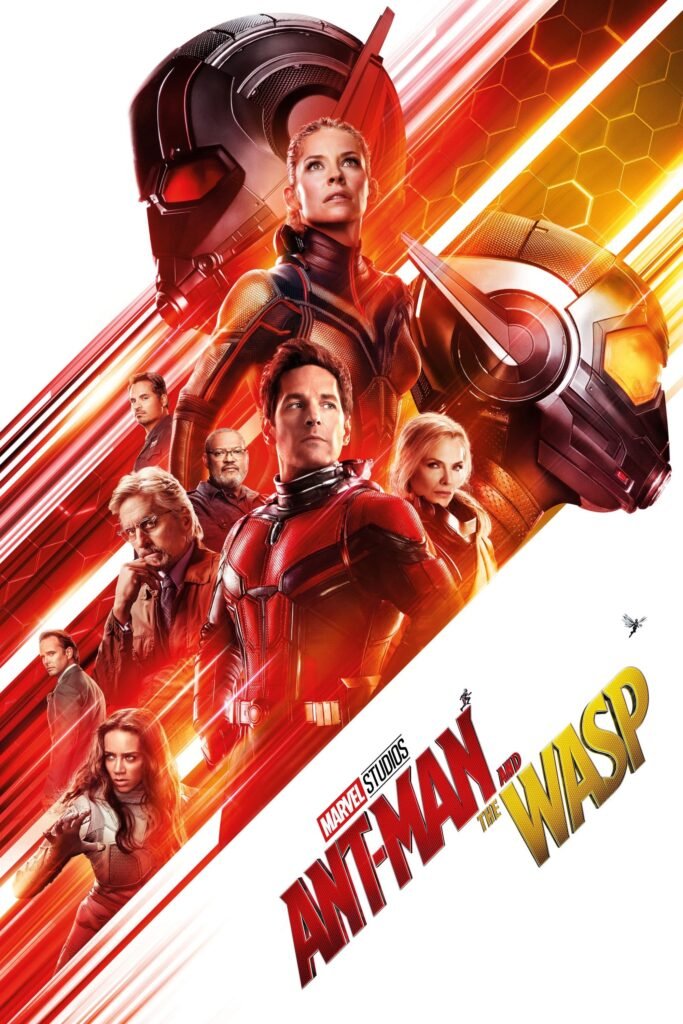
Ant-Man and the Wasp
Real heroes. Not actual size.
- Rating
Movie Details
Ant-Man and the Wasp, released in 2018 and directed by Peyton Reed, brings a lighter and more playful energy to the Marvel Cinematic Universe while still delivering high-stakes action and emotional storytelling. As a sequel to Ant-Man, the film expands the world of shrinking technology, introducing new challenges, new villains, and a deeper exploration of the Quantum Realm.
From the beginning, Ant-Man and the Wasp stands out because it balances superhero action with comedy and family-driven storytelling. Unlike some of the darker entries in the Marvel universe, this film keeps a more upbeat tone while still connecting to the larger storyline of the franchise.
The story takes place shortly after the events of Captain America: Civil War, where Scott Lang is dealing with the consequences of his actions as Ant-Man. Meanwhile, Hope van Dyne and Hank Pym are focused on a critical mission involving the mysterious Quantum Realm.
A Story of Rescue and Redemption
At the heart of Ant-Man and the Wasp is Scott Lang, played by Paul Rudd. Scott is trying to balance his life as a father with the restrictions placed on him after his involvement in the superhero conflict in Berlin.
However, things take a turn when he is pulled back into action by Hank Pym and Hope van Dyne. Hope, also known as the Wasp, becomes a central figure in the mission, finally stepping into her role as a fully equipped superhero.
The team’s main objective is to rescue Janet van Dyne, who has been trapped in the Quantum Realm for decades. Her disappearance years earlier has left emotional scars on both Hank and Hope, and finding her becomes a deeply personal mission.
As Scott becomes involved, he begins experiencing strange visions linked to the Quantum Realm, making him a key piece in unlocking its secrets.
The Quantum Realm and Scientific Mystery
One of the most fascinating elements of Ant-Man and the Wasp is the expansion of the Quantum Realm. This mysterious dimension, introduced in the first Ant-Man film, becomes central to the story’s science-fiction themes.
The Quantum Realm is not just a microscopic space—it behaves like an entirely different universe with its own rules of time, space, and energy. This concept allows the film to explore ideas about parallel realities and advanced quantum science within a superhero context.
As Hank Pym works to develop a way to safely enter the Quantum Realm, the stakes rise significantly. The technology involved is unstable and dangerous, creating tension throughout the story.
This scientific angle gives the movie a unique identity compared to other Marvel films that focus more heavily on cosmic or magical threats.
The Wasp Takes Center Stage
One of the most important developments in Ant-Man and the Wasp is the introduction of Hope van Dyne as a fully realized superhero. Played by Evangeline Lilly, Hope finally takes on the mantle of the Wasp, complete with her own advanced suit and combat abilities.
Unlike Scott, who often relies on improvisation and humor, Hope is highly trained, disciplined, and efficient in combat. This contrast creates a strong dynamic between the two heroes, especially during action sequences.
The Wasp’s abilities include flight, energy blasts, and advanced martial arts combat, making her a powerful counterpart to Ant-Man’s size-changing abilities. Together, they form a balanced team capable of handling complex missions.
Her role in the story also highlights themes of legacy and responsibility, as she works to continue her mother’s work while building her own identity as a hero.
The Antagonist and Moral Complexity
The film’s antagonist, Ghost, played by Hannah John-Kamen, adds emotional depth to the conflict. Unlike traditional villains, Ghost is not purely evil. Instead, she suffers from a condition caused by quantum instability, which makes her body phase in and out of reality.
Her condition causes pain and instability, driving her to seek a cure through any means necessary. This puts her in conflict with Hank, Hope, and Scott, who are also trying to access Quantum energy for their own goals.
This moral complexity makes the conflict more layered. Rather than a simple hero-versus-villain dynamic, the story becomes about competing survival needs and ethical choices.
Ghost’s abilities also make her a unique and unpredictable threat during action scenes, as she can pass through objects and appear suddenly in combat.
Humor, Action, and Emotional Balance
One of the strengths of Ant-Man and the Wasp is its ability to balance humor with emotional storytelling. Paul Rudd’s performance as Scott Lang continues to bring comedic timing and charm to the film, making even high-stakes moments feel grounded and relatable.
At the same time, the emotional relationship between Hank, Hope, and Janet gives the story real weight. Their shared goal of reuniting as a family adds depth to the scientific adventure.
The action scenes are creative and often playful, using size-changing mechanics in unique ways. Objects shift in scale during fights, cars become weapons, and environments constantly change in unexpected ways.
This creativity keeps the film visually engaging and different from typical superhero battles.
Why Ant-Man and the Wasp Stands Out
Ant-Man and the Wasp succeeds because it combines science fiction, comedy, and emotional storytelling into a cohesive and entertaining experience. It may not focus on world-ending threats like other Marvel films, but it offers something more intimate and inventive.
The introduction of the Wasp as a fully active hero strengthens the franchise and adds balance to the superhero duo. Meanwhile, the exploration of the Quantum Realm expands the Marvel universe in ways that would later become important to larger storylines.
Ultimately, the film works because it doesn’t try to be overly serious. Instead, it embraces fun, creativity, and character-driven storytelling, making Ant-Man and the Wasp a refreshing entry in the Marvel Cinematic Universe.