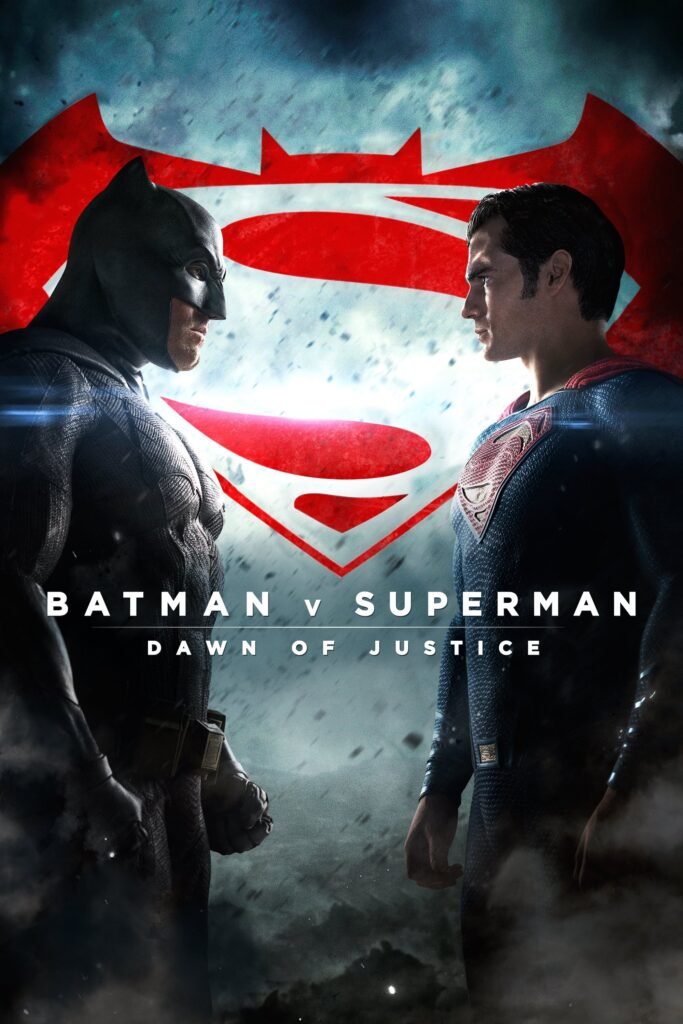
Batman v Superman: Dawn of Justice
The greatest gladiator match in the history of the world.
- Rating
Movie Details
Batman v Superman: Dawn of Justice is a bold and controversial superhero film released in 2016, directed by Zack Snyder. The movie brings together two of the most iconic characters in comic book history and places them on a collision course that reshapes the direction of the DC Extended Universe.
At the heart of Batman v Superman: Dawn of Justice is the ideological and physical clash between Batman and Superman. Batman, played by Ben Affleck, views Superman as an uncontrollable threat after witnessing the destruction caused during earlier battles in Metropolis. Meanwhile, Superman, portrayed by Henry Cavill, struggles with his role as a global protector under constant scrutiny and fear.
From the opening scenes, the film establishes a darker tone than typical superhero movies. It explores fear, power, and responsibility in a world still recovering from large-scale destruction caused by superhuman conflicts.
A Story Built on Fear and Misunderstanding
Batman v Superman: Dawn of Justice is driven by misunderstanding rather than clear villainy. Bruce Wayne sees Superman as a potential global threat that must be controlled or eliminated before he becomes dangerous. This fear is fueled by the devastation witnessed in previous battles involving Kryptonian forces.
On the other side, Clark Kent sees Batman as a violent vigilante who operates outside the law. His concern is not just personal morality but the broader consequences of unchecked justice.
This ideological divide forms the emotional core of Batman v Superman: Dawn of Justice. Instead of focusing on a traditional hero-versus-villain narrative, the film explores how fear can distort perception and lead to conflict between potential allies.
The tension escalates through manipulation by Lex Luthor, played by Jesse Eisenberg, who strategically fuels distrust between the two heroes. His actions push both Batman and Superman toward confrontation, even though their conflict is largely engineered.
The Clash of Two Icons
The battle between Batman and Superman is one of the most anticipated moments in modern superhero cinema. Their fight represents more than physical strength; it symbolizes two opposing philosophies about justice.
Batman relies on strategy, technology, and preparation. Superman embodies raw power, hope, and moral restraint. When they finally clash, the fight reflects these differences in every movement and decision.
The film carefully builds toward this confrontation, emphasizing emotional tension before action. Batman’s preparation includes advanced armor and tactical planning designed specifically to counter Superman’s abilities.
However, the battle is not simply about strength. It becomes a turning point where both characters begin to question their assumptions about each other.
The introduction of Wonder Woman, played by Gal Gadot, adds a new dimension to the conflict. Her appearance during the fight signals a larger threat and shifts the narrative toward unity rather than division.
Lex Luthor and the Manipulation of Power
A major driving force in Batman v Superman: Dawn of Justice is Lex Luthor’s manipulation of events. He operates behind the scenes, exploiting fear and political instability to push both heroes into conflict.
Luthor represents chaos disguised as intelligence. His goal is not just to defeat Superman but to prove that even gods can be broken through psychological pressure and strategic planning.
By orchestrating events that frame Superman and intensify Batman’s paranoia, Luthor successfully turns public opinion against the Man of Steel.
This manipulation highlights one of the film’s central themes: power without understanding can lead to fear, and fear can be easily exploited.
A Darker Vision of the Superhero World
Batman v Superman: Dawn of Justice takes a darker and more serious approach to superhero storytelling compared to other films in the genre. The tone is heavy, filled with moral questions and emotional conflict.
Cinematography, music, and pacing all contribute to a sense of seriousness and weight. The world depicted in the film is one where heroes are not universally trusted, and their actions are constantly questioned.
This approach divides opinion among audiences but also distinguishes the film from more traditional superhero narratives.
The presence of political debate, media reaction, and public fear adds realism to the consequences of superhuman activity.
The Rise of Something Bigger
While Batman v Superman: Dawn of Justice focuses on conflict, it also sets the foundation for a larger superhero universe. The introduction of metahumans and hidden files hints at future alliances and larger threats.
Wonder Woman’s role becomes especially important as she represents hope and balance between conflicting ideologies. Her presence suggests that unity may be necessary to face what is coming next.
The film ultimately transitions from division to the idea that cooperation is essential, even among the most powerful individuals.
Why Batman v Superman: Dawn of Justice Still Matters
Batman v Superman: Dawn of Justice remains a significant entry in superhero cinema because it attempts to explore deeper themes within a blockbuster format. It is not just about a fight between two icons, but about fear, trust, and the consequences of power.
By placing Batman and Superman on opposite sides, the film challenges the idea that heroes must always agree. Instead, it shows that even the greatest protectors can see the world differently.
Its impact continues to be discussed because it takes risks with tone, structure, and character interpretation, making it one of the more ambitious superhero films of its time.