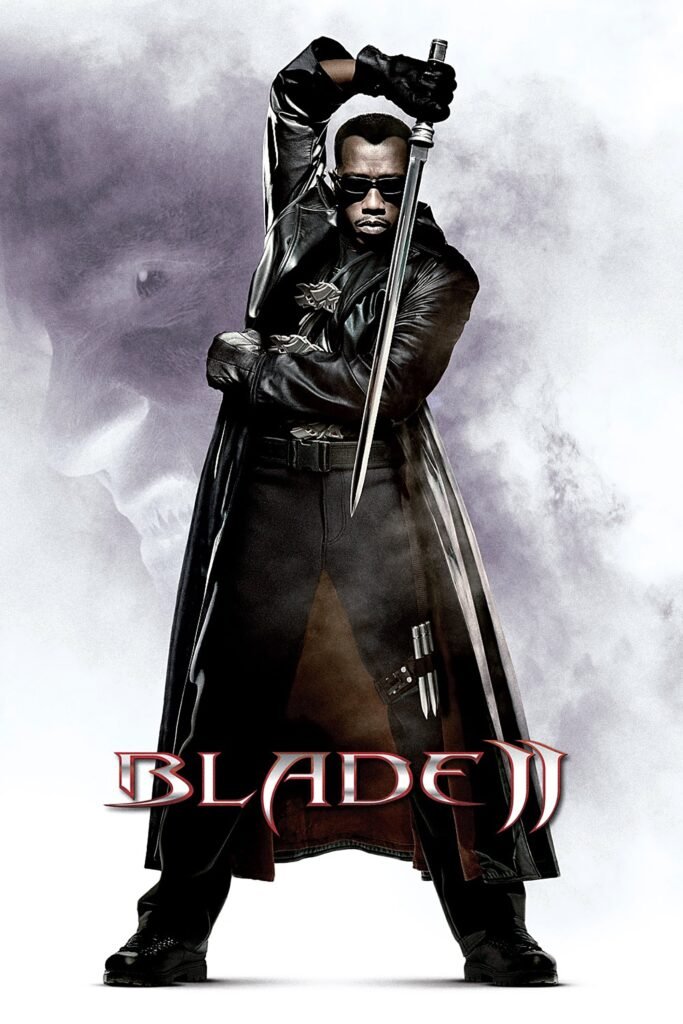
Blade II
Faster. Sharper. Deadlier.
- Rating
Movie Details
Blade II (2002) – A Darker, Wilder Vampire Action Evolution
Blade II (2002) arrives with a louder, darker, and more stylized energy than its predecessor, and right from the opening scenes, Blade II makes it clear this is not a simple continuation—it’s a full evolution of the vampire action world. Directed by Guillermo del Toro, the film takes everything established before and pushes it into a more monstrous, atmospheric direction.
As the story begins, Blade is still operating as a lone warrior, hunting vampires in a world where the line between human and monster continues to blur. However, this time the threat is different, more unpredictable, and far more dangerous than anything he has faced before.
Because of this shift, the film immediately establishes a sense of urgency and escalation.
A New Kind of Vampire Threat
At the heart of Blade II (2002) is the emergence of a new species of vampire, created through mutation and adaptation. Unlike traditional vampires, these creatures are faster, stronger, and far more aggressive. Their evolution makes them difficult to control, even by their own kind.
As this new threat spreads, it forces unlikely alliances to form. Vampires who would normally be enemies of Blade are now faced with a shared survival problem. This creates a tense and uneasy partnership that drives much of the narrative.
At the same time, Blade is forced to work alongside a specialized team designed to combat supernatural threats. While trust is limited, necessity pushes them together, even as tensions rise.
Because of this dynamic, the story constantly shifts between cooperation and conflict.
Blade’s Struggle Between Human and Monster
One of the central elements of Blade II (2002) is the internal struggle of its protagonist. Blade exists between two worlds—human and vampire—but fully belongs to neither.
This dual nature shapes his decisions and relationships throughout the film. While he hunts vampires relentlessly, he also carries traits that connect him to them. This creates an ongoing tension within his character.
As the story progresses, this internal conflict becomes more important, especially as new revelations about the vampire virus and its evolution come to light.
Because of this, Blade’s journey is not just external but deeply personal.
A Visual Style Driven by Atmosphere
One of the most distinctive aspects of Blade II (2002) is its visual identity. Guillermo del Toro brings a strong emphasis on gothic design, blending industrial environments with organic, creature-driven horror.
The result is a world that feels alive, dirty, and constantly shifting. Shadows dominate many scenes, while lighting is used to highlight both beauty and decay.
This visual style enhances the film’s tone, making every location feel dangerous and unpredictable. Whether underground lairs or dimly lit urban spaces, the atmosphere is consistently heavy and immersive.
Because of this, the film stands apart from more conventional action entries in the genre.
Action That Feels Brutal and Fast
The combat in Blade II is significantly more intense and fast-paced compared to the original film. Blade’s fighting style is aggressive, fluid, and highly physical, combining martial arts with weapon-based attacks.
Encounters are often chaotic, with multiple enemies attacking from different angles. This creates a sense of pressure that keeps the action unpredictable.
At the same time, the introduction of the new vampire breed raises the stakes in every fight. Their enhanced abilities force Blade and his allies to adapt quickly or risk being overwhelmed.
Because of this, action sequences feel less like structured fights and more like survival scenarios.
The Reaper Threat and Biological Horror
A major element of Blade II (2002) is the introduction of a new vampire mutation known as the Reapers. These creatures represent a biological escalation of the vampire condition, turning infected beings into uncontrollable predators.
Unlike traditional vampires, Reapers do not discriminate. They attack both humans and vampires, creating widespread chaos. This makes them a threat to everyone involved, forcing opposing sides to reconsider their priorities.
As the Reaper outbreak spreads, the story shifts toward containment and survival rather than simple conflict. This adds a layer of horror that blends seamlessly with the action.
Because of this, the film leans heavily into body horror and transformation themes.
Team Dynamics Under Pressure
Blade is joined by a group of vampire hunters who each bring different skills and personalities to the mission. However, trust between them is fragile at best.
Tensions arise quickly as differing goals and ideologies clash. Some members see Blade as an asset, while others view him as a potential threat.
This dynamic adds complexity to the story, especially as the stakes increase. Decisions must be made quickly, and disagreements often occur in the middle of dangerous situations.
Because of this, the team’s cohesion becomes just as important as their combat abilities.
Themes of Evolution and Survival
At its core, Blade II (2002) explores the idea of evolution—both biological and personal. The vampire virus itself is constantly changing, creating new forms of life that challenge existing power structures.
At the same time, Blade’s own identity is shaped by his hybrid nature. He exists as a result of transformation, making him both part of the system and separate from it.
This parallel between biological evolution and personal identity adds depth to the story. It raises questions about control, adaptation, and what it means to survive in a changing world.
Because of this, the film goes beyond action and enters more thematic territory.
Guillermo del Toro’s Signature Influence
Guillermo del Toro’s direction is clearly visible throughout Blade II (2002). His focus on creature design, practical effects, and atmospheric storytelling gives the film a distinct personality.
The vampire designs are especially notable, blending horror elements with physical realism. These creatures feel tangible and unsettling, enhancing the film’s darker tone.
At the same time, the world-building reflects a deeper mythology, suggesting that the vampire ecosystem is more complex than initially understood.
Because of this creative direction, the film stands out within its genre.
A Darker Expansion of the Blade Universe
Blade II builds on its foundation by expanding both the mythology and the scale of its world. It introduces new threats, new alliances, and new interpretations of what vampires can become.
While it maintains the core identity of the original, it pushes into more ambitious storytelling and visual design. This evolution gives the film a stronger sense of scope and intensity.
At the same time, it keeps Blade firmly at the center, ensuring that his journey remains the emotional anchor.
A High-Intensity Supernatural Action Experience
Blade II (2002) succeeds by combining fast-paced action with dark fantasy horror. Its focus on mutation, survival, and shifting alliances creates a story that constantly evolves.
The blend of stylized combat, atmospheric visuals, and creature-driven horror results in a unique cinematic experience.
In the end, it stands as a bold expansion of its universe, pushing its characters and mythology into darker and more unpredictable territory.