Chris Evans, Robert Downey Jr., Scarlett Johansson, Sebastian Stan, Anthony Mackie, Don Cheadle, Jeremy Renner, Chadwick Boseman, Paul Bettany, Elizabeth Olsen, Paul Rudd, Emily VanCamp, Tom Holland, Daniel Brühl, Frank Grillo, William Hurt, Martin Freeman, Marisa Tomei, John Kani, John Slattery, Hope Davis, Alfre Woodard, Michael A. Cook, Laughton Parchment, Jackson Spidell, Yi Long, Heidi Moneymaker, Aaron Toney, Cale Schultz, Ann Russo, Gene Farber, Florence Kasumba, Cornell John, Sven Hönig, Joshua Peck, Brent McGee, Be Satrazemis, Blair Jasin, Oliver Bigalke, Rafael Banasik, David de Vries, John Curran, Katie Amess, Austin Sanders, Brett Gentile, Matthew Anderson, Andrew Botchwey, Chase Bradfield, Ernest Charles, Hendricks Coates, Ethan Condon, Shen Dynes, Nathaniel Ellis, Jariah Ferguson, Evan Ffrench, Justin Freeman, Ralphael Grand'Pierre, Julian Grimes, Aaron Hayes, Austin Hooper, Amiri Jones, Myles Joseph, Stephen Lewis, Jacob Ludwick, D'Mahrei McRae, Ashwin Mudaliar, Eli Ollinger, Parker Pape, Daniel Parada, Jonah Ruffin, Darryl Sampson, Cameron Sardone, Stanley Sellers, Miles Selles, Jacob Sung, Caden Wilkinson, Jin Shijia, Jessica Walther-Gabory, Beniamino Brogi, Silvina Buchbauer, Henry Amadi, Ugochukwu Ani, Michael Anthony Rogers, Damion Poitier, Umar Khan, David E. Brown, Guy Fernandez, Jim Rash, Sophia Russo, Joe Russo, Stan Lee, Amelia Morck, Kerry Condon, Julianna Guill, Surely Alvelo, Brian Schaeffer, Kevin LaRosa Jr., Al Cerullo, Frédéric North, Ray Sahetapy, Chris Jai Alex, Scott Hunter, Kimberly Hester Huffstetler, Kevin Christenson
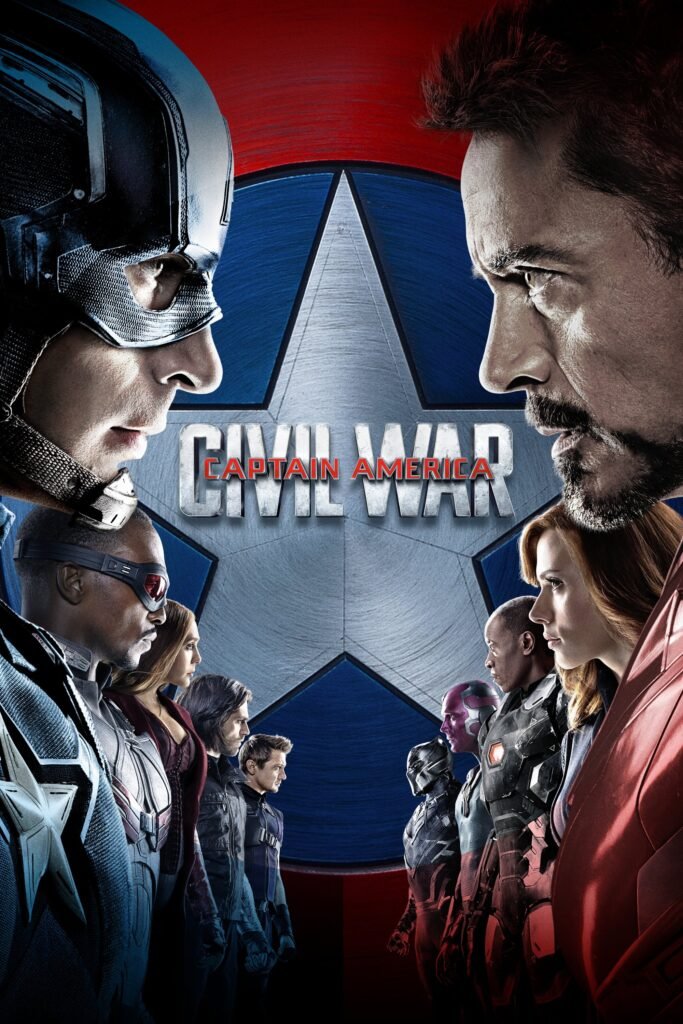
Following the events of Age of Ultron, the collective governments of the world pass an act designed to regulate all superhuman activity. This polarizes opinion amongst the Avengers, causing two factions to side with Iron Man or Captain America, which causes an epic battle between former allies.
Captain America: Civil War arrived in 2016 as one of the most ambitious entries in the Marvel Cinematic Universe. Directed by Anthony Russo and Joe Russo, the film transforms a political disagreement into a full-scale superhero conflict that reshapes the future of the Avengers.
From the beginning, Captain America: Civil War focuses on tension within the superhero community. Instead of facing an external alien threat, the heroes are divided by ideology, responsibility, and trust. This shift makes the story feel more grounded and emotionally charged compared to previous ensemble films.
At the center of the conflict is Captain America, played by Chris Evans. He believes superheroes should remain free from government control. On the opposing side is Iron Man, played by Robert Downey Jr., who supports regulation after years of destructive battles.
This ideological clash becomes the emotional backbone of Captain America: Civil War, turning former allies into opponents.
A Story Built on Conflict and Consequences
Unlike traditional superhero films focused on a single villain, Captain America: Civil War builds its tension through disagreement between heroes. The Sokovia Accords, a government initiative designed to regulate superhero activity, become the catalyst for division.
Tony Stark, also known as Iron Man, supports the Accords after reflecting on the destruction caused by past Avengers missions. Steve Rogers, however, fears that government oversight could lead to manipulation and loss of freedom.
This disagreement quickly escalates when a new threat emerges, further complicating the already fragile relationship between the heroes.
The emotional stakes increase when Bucky Barnes, also known as Winter Soldier, played by Sebastian Stan, becomes involved. His past actions and connection to Steve Rogers deepen the conflict and create personal tension between characters who once fought side by side.
As the story unfolds, the film explores themes of responsibility, loyalty, and moral uncertainty. No side is completely right or wrong, which makes the conflict feel more realistic and emotionally complex.
The Avengers Against Themselves
One of the most striking aspects of Captain America: Civil War is watching the Avengers split into opposing teams. Instead of fighting a common enemy, heroes battle each other based on personal beliefs.
Team Captain America includes characters like Falcon, Scarlet Witch, and Hawkeye, while Team Iron Man features Black Panther, Spider-Man, Black Widow, and War Machine.
The introduction of Black Panther, played by Chadwick Boseman, adds another layer of depth to the story. His presence brings a fresh perspective on justice and revenge while setting up his own future storyline.
Meanwhile, Spider-Man, played by Tom Holland, makes a memorable debut in the MCU. His youthful energy and humor provide contrast to the heavier emotional tone of the film.
The airport battle sequence remains one of the most iconic moments in modern superhero cinema. It perfectly showcases each character’s abilities while emphasizing the emotional weight of fighting former allies.
Action That Serves the Story
Captain America: Civil War delivers action sequences that are both visually impressive and emotionally meaningful. Every fight scene feels tied directly to character relationships rather than random destruction.
The choreography is tight and grounded, with each hero using abilities that reflect their personalities. Captain America relies on agility and defense, Iron Man uses advanced technology, and Black Panther moves with speed and precision driven by personal vengeance.
Unlike many large-scale superhero battles, the action in this film is not about saving the world from destruction. Instead, it is about personal conviction and fractured trust.
This approach makes every confrontation feel more intimate and impactful. Even smaller fights carry emotional weight because they represent deeper ideological divides.
The final confrontation between Steve Rogers, Tony Stark, and Bucky Barnes stands out as the emotional climax of the film. It strips away the larger team dynamics and focuses on personal betrayal and unresolved trauma.
Emotional Depth Behind the Superhero Conflict
What sets Captain America: Civil War apart is its emotional storytelling. While the film features spectacular action, its core strength lies in character development.
Steve Rogers is driven by loyalty and personal history, especially his connection to Bucky Barnes. Tony Stark, on the other hand, is motivated by guilt and responsibility for past destruction.
These emotional motivations make the conflict feel grounded and believable. Instead of good versus evil, the film presents a clash of perspectives shaped by trauma and experience.
Supporting characters also receive meaningful moments that reinforce the central themes. Even characters with limited screen time contribute to the larger emotional narrative.
Why Captain America: Civil War Stands Out
Captain America: Civil War remains one of the most important films in the Marvel Cinematic Universe because it fundamentally changes the relationships between its characters.
By turning heroes against each other, the film explores what happens when trust breaks down within a team built on unity. It challenges the idea of absolute morality and shows that even heroes can disagree on what is right.
The combination of strong character writing, emotional conflict, and well-executed action makes Captain America: Civil War a standout entry in the superhero genre. It is both a thrilling blockbuster and a deeply personal story about friendship, responsibility, and division.