Super
Shut up, crime!
- Rating
Movie Details
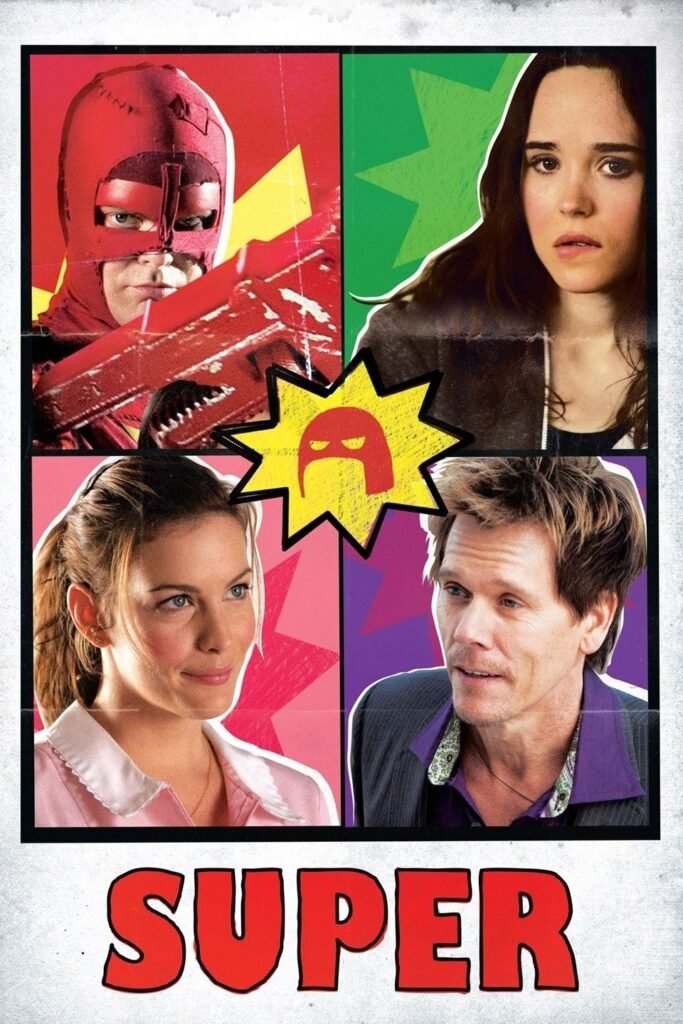
Super is a 2010 dark superhero comedy film written and directed by James Gunn. Released during a time when superhero cinema was becoming increasingly mainstream, Super takes a very different route by stripping away glamour and fantasy to present a gritty, uncomfortable, and often absurd look at what happens when an ordinary person tries to become a superhero.
Unlike traditional Marvel or DC-style stories, Super is not built around polished heroism or world-saving stakes. Instead, it focuses on emotional instability, violence, and moral confusion, all wrapped in a low-budget indie aesthetic that emphasizes realism over spectacle.
Story and Psychological Breakdown
The story follows Frank Darbo, an average man whose life falls apart after his wife Sarah leaves him for a drug dealer named Jacques. Struggling with loneliness and a deep sense of injustice, Frank experiences a religious vision that inspires him to become a vigilante superhero known as “The Crimson Bolt.”
Armed with nothing but a pipe wrench and an intense belief in justice, Frank begins attacking petty criminals. His actions are clumsy, violent, and often misguided, reflecting his unstable mental state.
Soon, Frank meets Libby, a comic book store clerk who becomes obsessed with his mission. She reinvents herself as “Boltie” and becomes his enthusiastic but extremely dangerous partner. Unlike Frank, Libby fully embraces violence without hesitation, escalating their actions into increasingly brutal encounters with criminals.
As the story unfolds, Super explores how Frank’s idealized vision of heroism collapses under real-world consequences. His mission to “do good” becomes blurred with revenge, obsession, and psychological breakdown.
Direction and Creative Style
James Gunn’s direction in Super is intentionally uncomfortable. The film blends dark comedy with sudden bursts of violence, creating a tone that constantly shifts between absurd and disturbing.
Unlike traditional superhero films, Super avoids polished action sequences or grand visual effects. Instead, it uses handheld camera work, awkward pacing, and raw performances to emphasize realism. This stylistic choice reinforces the idea that real-life “superheroes” would not be glamorous or clean.
The 2010 release also reflects a period where independent superhero films were experimenting with darker themes, long before the genre became fully saturated with blockbuster franchises.
Universe and Genre Approach
Super does not belong to the Marvel or DC universes. Instead, it exists as a grounded, fictional version of the real world where comic books influence people’s perceptions of justice.
The film heavily critiques superhero mythology by stripping away fantasy elements and showing how dangerous real-world vigilantism can be. Frank’s lack of powers and training highlights the gap between comic book fantasy and reality.
Libby’s character further challenges the idea of heroism, as she embraces violence not as a means of justice but as an identity.
Violence, Humor, and Tone
One of the most defining aspects of Super is its unpredictable tone. The film shifts rapidly between dark humor, emotional breakdowns, and intense violence. This creates a viewing experience that is deliberately uncomfortable.
The violence is often abrupt and exaggerated, not meant for glorification but to highlight the consequences of Frank and Libby’s actions. At the same time, moments of awkward humor break tension, reinforcing the film’s satirical edge.
This tonal imbalance is intentional, designed to make audiences question what they expect from superhero stories.
Character Study and Themes
At its core, Super is a character study about obsession, loneliness, and identity. Frank’s transformation into The Crimson Bolt is not driven by strength or destiny, but by emotional instability and desperation.
Libby, on the other hand, represents unchecked enthusiasm for violence. Her character raises uncomfortable questions about morality, influence, and psychological imbalance.
The film explores several key themes:
- The danger of vigilante justice
- The psychological effects of isolation
- The influence of pop culture on real behavior
- The blurred line between heroism and madness
Rather than presenting clear answers, Super leaves viewers in a morally uncertain space.
Release Context and Reception
Released in 2010, Super arrived before James Gunn became widely known for major superhero blockbusters. At the time, it stood out as a risky, unconventional project that challenged genre expectations.
The film received mixed reactions upon release. Some viewers praised its originality and bold storytelling, while others were unsettled by its violence and tonal shifts. Over time, however, it gained recognition as an important cult film within the superhero genre.
Its influence can be seen in later projects that explore darker, more deconstructed versions of heroism.
Legacy and Impact
Although not a mainstream success, Super remains an important entry in modern superhero cinema. It demonstrated that superhero stories could be used to explore psychological depth, moral ambiguity, and social commentary.
James Gunn’s later success with larger superhero projects highlights how Super served as an early exploration of themes he would revisit in more commercial formats.
Today, Super is often discussed as a bold, uncomfortable, but meaningful deconstruction of superhero culture.