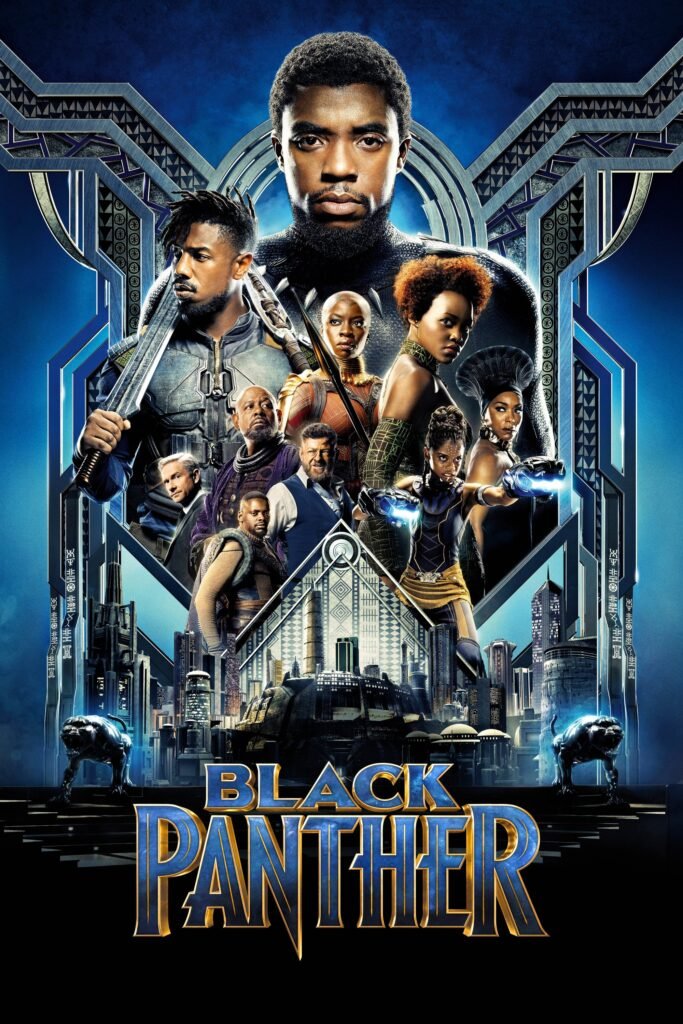
Black Panther
Long live the king.
- Rating
Movie Details
Black Panther, released in 2018 and directed by Ryan Coogler, became one of the most influential superhero films ever made. More than just a blockbuster, Black Panther delivered a powerful mix of action, culture, and emotional storytelling that set it apart within the Marvel Cinematic Universe.
From its opening scenes, the film introduces Wakanda, a hidden African nation that has developed advanced technology thanks to the rare metal vibranium. Unlike other nations in the Marvel world, Wakanda has remained isolated from global conflicts, protecting its identity and resources from outside influence.
At the center of the story is T’Challa, the prince of Wakanda, who becomes king after the death of his father. As he takes on the mantle of Black Panther, he must also face challenges that test his leadership, morality, and understanding of his nation’s role in the world.
The Rise of T’Challa as Black Panther
T’Challa, played by Chadwick Boseman, is introduced as a noble and disciplined leader-in-training. However, becoming king is not just a ceremonial transition—it comes with political pressure, ancestral responsibility, and external threats that could destabilize Wakanda.
After his father’s death, T’Challa must undergo traditional rituals to officially claim the throne. But his rule is quickly challenged by the return of a dangerous rival with a personal connection to Wakanda’s past.
As Black Panther, T’Challa gains enhanced strength, agility, and reflexes through the power of the heart-shaped herb. This transformation connects him spiritually to his ancestors and gives him the abilities needed to protect his kingdom.
However, his greatest challenge is not physical strength—it is leadership. He must decide whether Wakanda should remain isolated or open itself to the outside world.
Wakanda: A Hidden Technological Powerhouse
One of the most remarkable aspects of Black Panther is the world-building of Wakanda. Unlike many fictional nations in superhero films, Wakanda feels fully developed, with its own cultures, languages, traditions, and technology.
The city blends futuristic technology with traditional African aesthetics, creating a unique visual identity that stands out in the Marvel universe. Vibranium technology powers everything from weapons to transportation systems, making Wakanda one of the most advanced civilizations on Earth.
Despite its technological superiority, Wakanda remains hidden from global awareness, choosing secrecy over influence. This isolation becomes a central conflict in the story, especially as external forces begin to learn the truth about the nation.
The contrast between tradition and innovation plays a major role throughout the film, shaping both the setting and the moral dilemmas faced by its characters.
Killmonger and the Conflict of Ideologies
The main antagonist of Black Panther is Erik Killmonger, played by Michael B. Jordan. Unlike typical villains, Killmonger is not motivated by simple destruction or greed. Instead, his motivations come from a deep sense of injustice and personal history connected to Wakanda.
Having grown up outside Wakanda, Killmonger believes the nation has a responsibility to use its power to change the world, especially to help oppressed communities. His perspective directly challenges T’Challa’s belief in isolation and protectionism.
This ideological conflict is one of the strongest elements of the film. It forces both characters—and the audience—to question what responsibility a powerful nation should have toward the rest of the world.
Killmonger’s combat skills and tactical intelligence make him a formidable opponent for Black Panther. His presence pushes T’Challa to rethink his leadership and the future of Wakanda.
Action, Technology, and Vibranium Power
The action sequences in Black Panther combine martial arts combat with advanced technology powered by vibranium. Battles take place in diverse environments, including royal palaces, futuristic cities, and remote landscapes.
The Black Panther suit itself is one of the most iconic elements of the film. It absorbs kinetic energy and releases it in powerful bursts, giving T’Challa a unique fighting style that blends defense and offense.
The Dora Milaje, Wakanda’s elite all-female warrior group, also play a major role in combat scenes. Their disciplined fighting style and loyalty to the throne add depth and strength to Wakanda’s defense system.
Technology is not just a visual feature—it is deeply tied to the story’s themes. Vibranium represents both opportunity and danger, depending on how it is used.
Cultural Impact and Representation
Beyond its story and action, Black Panther had a major cultural impact upon release. It became a symbol of representation in mainstream cinema, showcasing a predominantly Black cast in a major superhero blockbuster.
The film highlighted African-inspired design, music, and storytelling elements, helping bring greater diversity to the superhero genre. Its success proved that global audiences were eager for stories rooted in different cultural perspectives.
The performances, visuals, and world-building contributed to making Wakanda feel like a living, breathing civilization rather than just a fictional backdrop.
Why Black Panther Remains a Landmark Film
Black Panther stands out because it successfully combines superhero action with meaningful storytelling and cultural significance. It is both an entertaining blockbuster and a thoughtful exploration of leadership, identity, and responsibility.
Ryan Coogler’s direction ensures that every element—from character development to visual design—serves a larger narrative purpose. The film’s balance of emotional depth and action spectacle helped it resonate with audiences worldwide.
Even years after its release, Black Panther remains one of the most important entries in the Marvel Cinematic Universe. It redefined what superhero films could represent while delivering a powerful and memorable story centered on the rise of a king and the future of Wakanda.