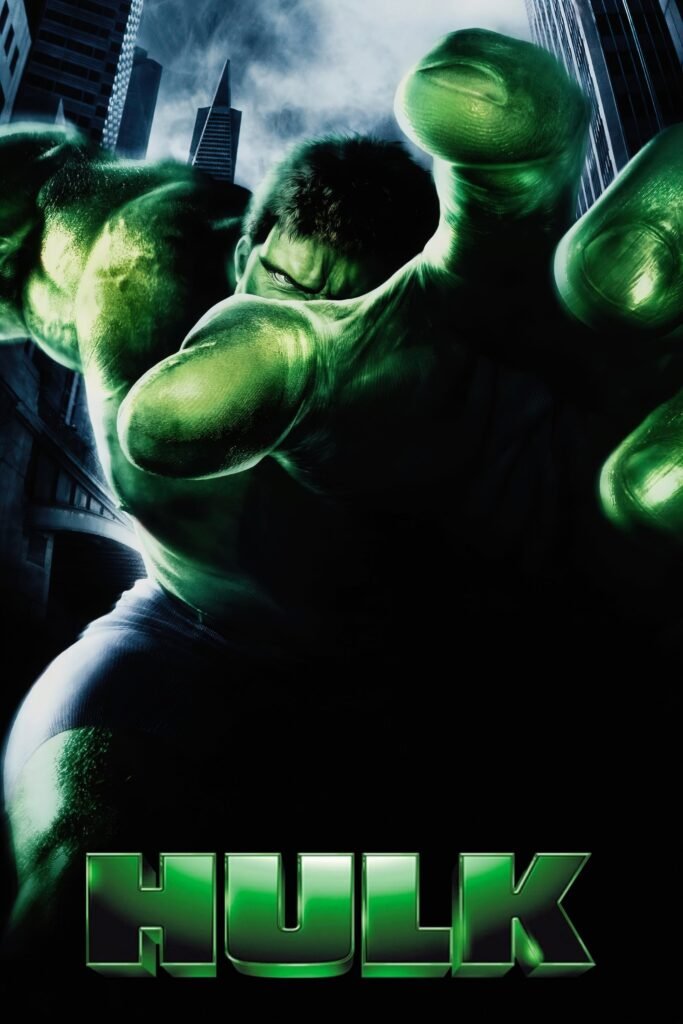
Hulk
What if everything you were forced to keep inside was suddenly set free?
- Rating
Movie Details
Hulk (2003) – A Psychological Take on Power and Transformation
Hulk (2003) stands apart from typical superhero films of its time, and right from the opening moments, Hulk makes it clear that this isn’t just about action—it’s about identity, trauma, and the consequences of unchecked power. Directed by Ang Lee, the film takes a more introspective approach, focusing as much on Bruce Banner’s inner struggles as it does on the destruction caused by his transformation.
As the story begins, Bruce Banner is introduced as a brilliant scientist working on advanced research involving cellular regeneration. He appears calm and controlled, but there’s an underlying tension that hints at something unresolved beneath the surface. That quiet unease becomes more important as the narrative unfolds.
Because of this setup, the film immediately establishes a tone that feels more psychological than purely action-driven.
The Origin of the Hulk
The turning point in Hulk (2003) comes when a laboratory accident exposes Bruce to high levels of gamma radiation. While he initially survives without obvious consequences, it soon becomes clear that something has changed.
Instead of a straightforward transformation, the Hulk emerges as a response to Bruce’s emotional state, particularly anger. This connection between emotion and physical change becomes central to the story.
As Bruce struggles to understand what’s happening to him, the film reveals that his condition is tied to deeper issues, including his past and his relationship with his family.
Because of this, the Hulk is not just a result of science—it’s also a manifestation of something more personal.
A Story Rooted in Trauma
One of the most distinctive elements of Hulk (2003) is its focus on psychological themes. Bruce’s transformation is closely linked to his childhood and the trauma he experienced growing up.
As the story progresses, memories and suppressed emotions begin to surface, shaping how and when the Hulk appears. This adds a layer of complexity that goes beyond the typical superhero origin.
At the same time, the film explores how unresolved pain can influence behavior and identity. Bruce’s struggle is not just about controlling the Hulk—it’s about understanding himself.
Because of this, the narrative feels more introspective than action-focused, even during its most intense moments.
The Hulk as Power Without Limits
When the Hulk emerges, he represents raw, uncontrollable power. Unlike more controlled heroes, the Hulk acts on instinct, driven by emotion rather than logic.
This lack of control creates both awe and fear. On one hand, the Hulk is capable of incredible feats of strength. On the other, that same power can lead to widespread destruction.
As the military becomes aware of his existence, Bruce is seen as a threat rather than a victim. This leads to a series of confrontations that escalate quickly.
Because of this dynamic, the Hulk becomes both a protector and a danger at the same time.
Action That Reflects Emotional Intensity
The action sequences in Hulk (2003) are designed to reflect the character’s emotional state. The more intense Bruce’s feelings become, the more powerful the Hulk grows.
This connection creates a direct link between character development and action. Each confrontation is not just a physical battle—it’s also an emotional release.
At the same time, the scale of destruction increases as the story progresses. What begins as isolated incidents evolves into large-scale conflicts that attract widespread attention.
Because of this, the action feels tied to the narrative rather than existing separately from it.
A Unique Visual Style
Visually, Hulk (2003) takes a different approach compared to other films in the genre. Ang Lee incorporates techniques inspired by comic book panels, using split screens and stylized transitions to tell the story.
This approach creates a distinct rhythm, allowing multiple perspectives to unfold simultaneously. It also reinforces the idea that the story is rooted in its comic book origins.
At the same time, the visual effects used to bring the Hulk to life emphasize his size and strength, making him feel both powerful and unpredictable.
Because of this combination, the film stands out visually, even years after its release.
Relationships That Shape the Story
While the Hulk is the central focus, the relationships surrounding Bruce Banner play a crucial role in shaping the narrative. These connections provide insight into his past and influence his present decisions.
Some characters represent stability and understanding, while others introduce conflict and tension. These dynamics help drive the story forward, especially as Bruce’s condition becomes more difficult to control.
Because of this, the emotional stakes remain high, even when the focus shifts away from action.
Themes of Control and Identity
At its core, Hulk (2003) is about control—both losing it and trying to regain it. Bruce’s struggle with the Hulk reflects a broader theme of managing one’s emotions and identity.
The film raises questions about whether true control is possible, or if some aspects of human nature are inherently unpredictable.
At the same time, it explores the idea of identity as something shaped by both past experiences and present choices. Bruce must confront who he is, not just who he wants to be.
Because of this, the story carries a deeper meaning beyond its surface-level conflict.
A Different Kind of Superhero Film
Hulk (2003) doesn’t follow the typical formula of its genre. Instead of focusing primarily on heroism, it examines the cost of power and the complexity of human emotion.
This approach may feel slower or more reflective compared to other films, but it allows for a more detailed exploration of its central character.
At the same time, it challenges expectations by presenting a protagonist who is not fully in control of his abilities.
Because of this, the film offers a unique perspective within the superhero landscape.
A Character Study Wrapped in Action
Hulk succeeds in presenting a story that blends action with psychological depth. It doesn’t shy away from exploring difficult themes, even as it delivers moments of spectacle.
The balance between introspection and intensity creates an experience that feels both thoughtful and engaging.
In the end, Hulk (2003) stands as a film that prioritizes character and emotion, offering a deeper look at what it means to carry power that cannot always be controlled.