James McAvoy, Michael Fassbender, Jennifer Lawrence, Rose Byrne, Kevin Bacon, January Jones, Nicholas Hoult, Lucas Till, Zoë Kravitz, Caleb Landry Jones, Oliver Platt, Jason Flemyng, Edi Gathegi, Matt Craven, Álex González, Rade Šerbedžija, Glenn Morshower, Laurence Belcher, Bill Milner, Morgan Lily, Beth Goddard, Éva Magyar, Corey Johnson, Demetri Goritsas, Don Creech, James Remar, Ludger Pistor, Wilfried Hochholdinger, Greg Kolpakchi, Andrei Zayats, Ray Wise, Michael Medeiros, Olek Krupa, Yuri Naumkin, Gene Farber, David Agranov, Katrine De Candole, James Faulkner, Annabelle Wallis, Juan Herrera, Greg Savage, Jarid Faubel, Gregory Cox, Josh Cohen, David Crow, Kieran Patrick Campbell, Sasha Pieterse, Brendan Fehr, Michael Ironside, Jason Beghe, Venya Manzyuk, Tony Curran, Randall Batinkoff, Peter Stark, Leonard Redlich, Carlos Peres, Sean Brown, Neil Fingleton, Georg Nikoloff, Arthur Darbinyan, Hugh Jackman, Rebecca Romijn, David Joseph Martinez, Johnny Otto, Josh Ramsay, John Snowden, Leonardo Castro Sitiriche
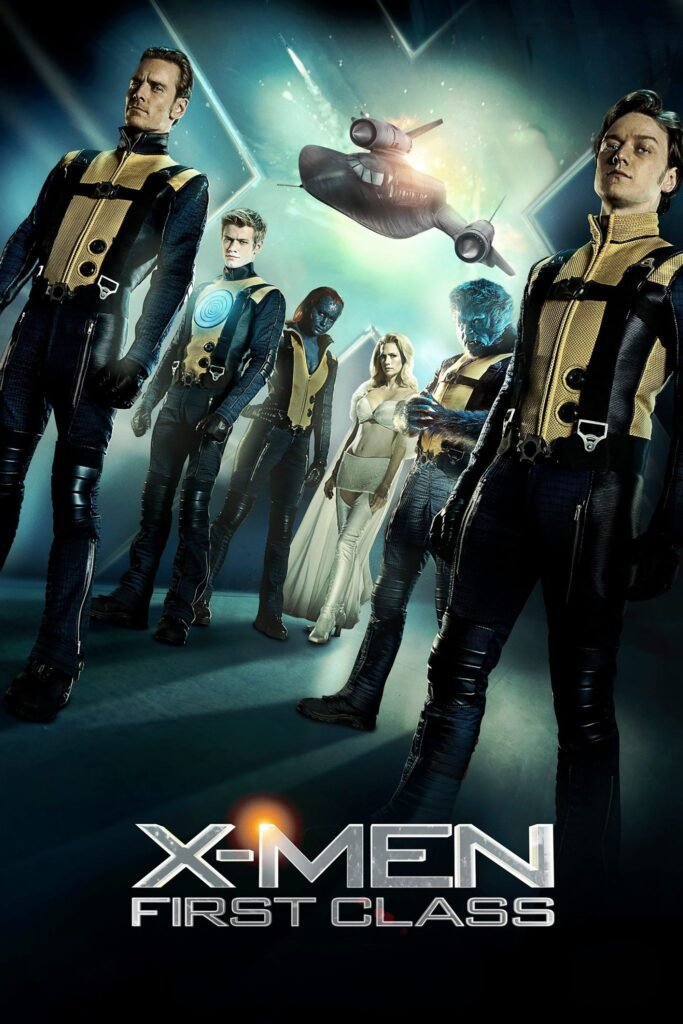
Before Charles Xavier and Erik Lensherr took the names Professor X and Magneto, they were two young men discovering their powers for the first time. Before they were arch-enemies, they were closest of friends, working together with other mutants (some familiar, some new), to stop the greatest threat the world has ever known.
X-Men: First Class Brought New Energy to the Franchise
X-Men: First Class arrived in 2011 at a critical moment for the mutant film series. Directed by Matthew Vaughn, the movie acted as both a prequel and a soft reboot, introducing younger versions of legendary mutant characters while exploring the origins of their complicated relationships.
Unlike earlier entries that focused heavily on large-scale action, X-Men: First Class leaned into character development, political tension, and emotional storytelling. As a result, the movie quickly became one of the most respected entries in the franchise. It combined superhero spectacle with spy thriller elements, giving the series a fresh identity that felt stylish and surprisingly grounded.
Set during the Cold War, the film uses real historical tension as the backdrop for its mutant conflict. That decision helped the story feel more mature while still delivering the powers, battles, and visual effects fans expected from a major comic book adaptation.
A Fresh Take on Charles Xavier and Erik Lehnsherr
One of the biggest strengths of X-Men: First Class is the relationship between Charles Xavier and Erik Lehnsherr. Before becoming Professor X and Magneto, they are presented as intelligent, ambitious young men who genuinely respect one another.
James McAvoy portrays Charles as charismatic, optimistic, and determined to help mutants coexist peacefully with humanity. Meanwhile, Michael Fassbender delivers a powerful performance as Erik, a man shaped by trauma and driven by anger against oppression.
Their friendship becomes the emotional center of the movie. Even when they disagree politically and morally, the connection between them never feels forced. Instead, the story carefully builds the foundation for the conflict audiences already know is coming.
Because of this dynamic, X-Men: First Class feels more personal than many superhero movies from the same era.
The Cold War Setting Adds Real Tension
The 1960s setting gives the film a unique identity compared to other superhero movies. Rather than focusing solely on saving cities from destruction, the movie ties its mutant conflict directly into the Cuban Missile Crisis.
This historical backdrop adds urgency and political intrigue. Governments fear nuclear war, while mutants begin realizing their existence could completely reshape global power structures.
The retro visual style also works incredibly well. From costumes and military designs to music and cinematography, the movie captures the atmosphere of the early 1960s without feeling overly nostalgic.
At the same time, the setting allows X-Men: First Class to explore themes of fear, discrimination, and power in a way that feels meaningful rather than superficial.
Matthew Vaughn’s Stylish Direction
Director Matthew Vaughn brought a very different tone to the franchise. His approach mixed fast pacing, stylish visuals, and sharp dialogue with emotional character moments.
The action scenes feel energetic without becoming overwhelming. Vaughn also keeps the movie moving smoothly, balancing quieter conversations with explosive mutant battles.
What makes the direction stand out is how confident the film feels. It embraces comic book concepts while still treating its characters seriously. The movie never becomes too dark or overly comedic, finding a balance that keeps the tone engaging throughout.
Additionally, Vaughn’s experience with action filmmaking helps several sequences stand out, especially moments involving Magneto’s powers and the mutant training scenes.
A Strong Supporting Cast of Mutants
Beyond Charles and Erik, X-Men: First Class introduces a large cast of younger mutants who each contribute something memorable to the story.
Jennifer Lawrence plays Mystique with a level of vulnerability that helps the audience understand her growing frustration and isolation. Nicholas Hoult gives Beast an awkward charm that contrasts nicely with the more confident personalities around him.
Kevin Bacon also delivers a memorable performance as Sebastian Shaw, the film’s primary antagonist. Rather than being a simple villain, Shaw represents manipulation, ambition, and extremist ideology.
The supporting cast helps the movie feel like a true team story. Every character may not receive equal screen time, but most contribute to the evolving themes surrounding identity and belonging.
Action Sequences That Still Hold Up
Even though the movie focuses heavily on character relationships, the action scenes remain impressive more than a decade later.
Magneto’s abilities are especially showcased in creative ways throughout the film. His scenes combine emotional intensity with visually satisfying moments that highlight how dangerous and powerful he can become.
The training sequences also give the younger mutants opportunities to develop their powers while adding humor and energy to the movie.
Meanwhile, the large-scale climax delivers spectacle without losing sight of the emotional conflict between Charles and Erik. That balance helps the action feel meaningful instead of existing purely for visual excitement.
Why X-Men: First Class Still Stands Out
Superhero movies became increasingly common during the 2010s, yet X-Men: First Class managed to stand apart because of its tone and storytelling approach.
Rather than relying entirely on massive destruction or nonstop jokes, the movie prioritizes relationships, ideology, and emotional stakes. It understands that the mutant concept works best when tied to human conflict and personal identity.
The film also successfully revitalized the franchise after mixed reactions to some earlier entries. Many fans appreciated the younger cast, grounded storytelling, and stronger focus on character development.
Additionally, X-Men: First Class influenced later superhero films by proving audiences would embrace stories that combined comic book action with historical and political themes.
The Legacy of X-Men: First Class
Over time, X-Men: First Class earned a reputation as one of the strongest mutant films ever made. It introduced a new generation of actors while successfully modernizing classic comic book characters.
The movie also laid the foundation for future entries that expanded the timeline and explored more ambitious storylines. Without its success, the franchise likely would have taken a very different direction.
What continues to make X-Men: First Class memorable is its balance. It delivers action, emotion, humor, and political tension without losing focus on its central characters.
For many viewers, the movie represents the moment the franchise rediscovered what made the X-Men compelling in the first place: complex characters trying to find their place in a world that fears them.