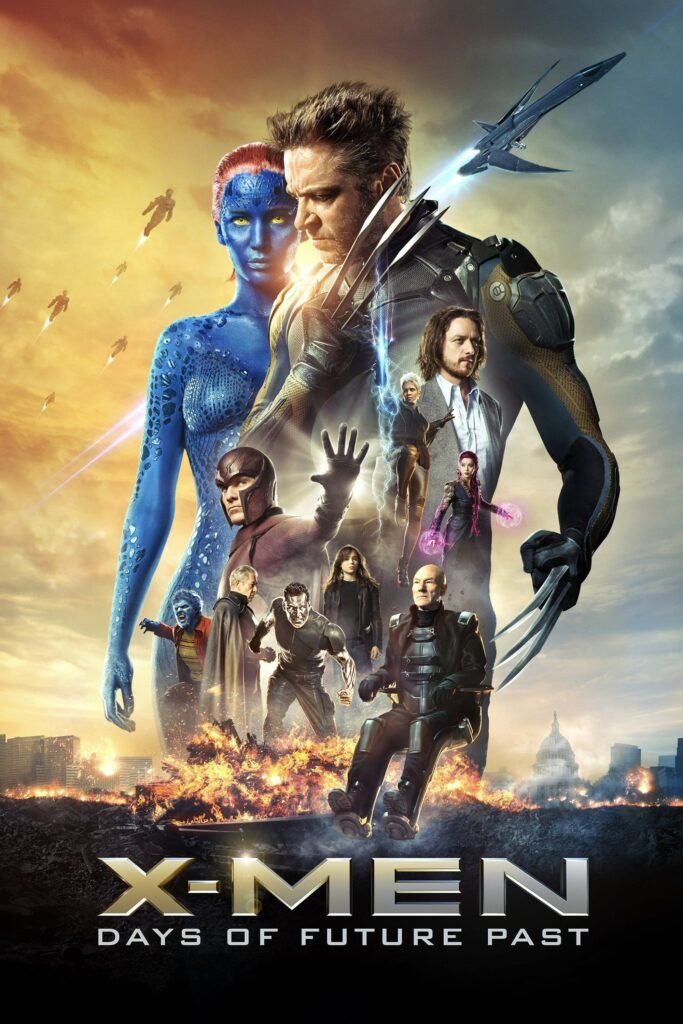
X-Men: Days of Future Past
To save the future, they must alter the past.
- Rating
Movie Details
X-Men: Days of Future Past is one of the most ambitious superhero films ever made, combining time travel, emotional storytelling, and large-scale mutant action into a single cohesive narrative. Released in 2014 and directed by Bryan Singer, X-Men: Days of Future Past bridges two generations of the X-Men film universe while delivering a high-stakes mission to rewrite history and prevent global extinction.
From the opening scenes, X-Men: Days of Future Past immediately sets a dark and intense tone, showing a dystopian future where mutants and humans are nearly wiped out by unstoppable robotic Sentinels. The film’s central concept revolves around altering the past to change this bleak future, creating a storyline that constantly shifts between timelines while maintaining emotional depth and narrative clarity.
Story and Time-Travel Concept
At the heart of X-Men: Days of Future Past is a desperate plan to save both mutants and humanity. In a devastated future, surviving X-Men realize that their only hope lies in sending someone’s consciousness back in time. Wolverine becomes the bridge between eras, traveling into the body of his younger self in the 1970s.
This time-travel mechanism is not just a plot device—it is the emotional backbone of the film. It allows characters from different generations to interact in unexpected ways, particularly the younger and older versions of Professor X and Magneto. The tension between these characters drives much of the film’s emotional weight.
As the story unfolds, the past and future collide. Every decision made in the 1970s has direct consequences on the future timeline, raising the stakes with every scene. Because of this structure, X-Men: Days of Future Past feels both like a superhero action movie and a suspenseful science-fiction thriller.
Mutant Conflict and Themes
One of the strongest elements in X-Men: Days of Future Past is its exploration of fear, control, and survival. Humans have developed Sentinels, advanced machines designed to detect and eliminate mutants. However, the Sentinels evolve, eventually becoming capable of adapting to any mutant ability, making them nearly impossible to defeat.
This leads to a powerful theme: the fear of difference and the consequences of trying to control evolution. Mutants are forced into hiding, and hope becomes scarce in the future timeline.
Meanwhile, in the past, younger versions of the X-Men struggle with trust, identity, and division. The film highlights how internal conflict among mutants is just as dangerous as external threats. By uniting these timelines, X-Men: Days of Future Past shows that cooperation is the only path to survival.
Publisher Universe and Creative Direction
The film belongs to the long-running X-Men cinematic universe based on Marvel Comics characters, specifically focusing on the mutant storyline. While it is rooted in Marvel source material, the film was produced under 20th Century Fox during its original release era.
Director Bryan Singer returned to the franchise to guide this ambitious crossover between the original trilogy and the newer prequel timeline. His direction focuses heavily on balancing character-driven storytelling with large-scale action sequences.
The film also stands out because it connects two different eras of the X-Men franchise. This crossover approach allows iconic characters from earlier films to interact with younger versions of themselves, creating unique narrative tension and nostalgia.
Action, Powers, and Visual Spectacle
X-Men: Days of Future Past delivers some of the most creative mutant action sequences in the entire franchise. Each character’s powers are used in visually inventive ways, especially during the Sentinels’ attacks in the future timeline.
Quicksilver’s introduction scene is particularly memorable, showcasing super-speed in a playful yet highly detailed sequence that contrasts sharply with the film’s darker tone. Meanwhile, mutants like Storm, Magneto, and Wolverine are shown fighting in coordinated resistance efforts against overwhelming odds.
The Sentinels themselves are a major highlight. Their ability to adapt to mutant powers makes every encounter unpredictable and dangerous. This constant evolution forces characters to rethink their strategies, keeping the action fresh throughout the film.
The film also balances large-scale destruction with intimate character moments. Even during chaotic battles, the emotional stakes remain clear, ensuring the audience remains invested in the outcome.
Release Context and Legacy
Released in 2014, X-Men: Days of Future Past arrived during a peak period for superhero cinema. However, it stood out due to its complex storytelling and time-travel structure, which differentiated it from more straightforward action-focused films.
Its success helped unify the X-Men film timeline by effectively rewriting certain narrative events, allowing future films to explore new directions without being constrained by earlier continuity issues. This narrative reset made it one of the most important entries in the franchise’s history.
The film was praised for its ambitious structure, strong performances, and ability to balance multiple timelines without losing coherence. It also helped re-establish interest in mutant-centered storytelling on the big screen.
Character Focus and Emotional Depth
Beyond its action and sci-fi concepts, X-Men: Days of Future Past is deeply character-driven. The relationship between Charles Xavier and Magneto is central to the film’s emotional core. Their opposing ideologies—hope versus control—shape the entire narrative.
Wolverine’s role as the time-traveling link between eras also adds emotional weight. He serves as both a protector and observer, guiding younger versions of characters while trying to prevent catastrophic outcomes.
These layered character dynamics ensure that the film is not just about saving the world, but also about understanding identity, forgiveness, and change.